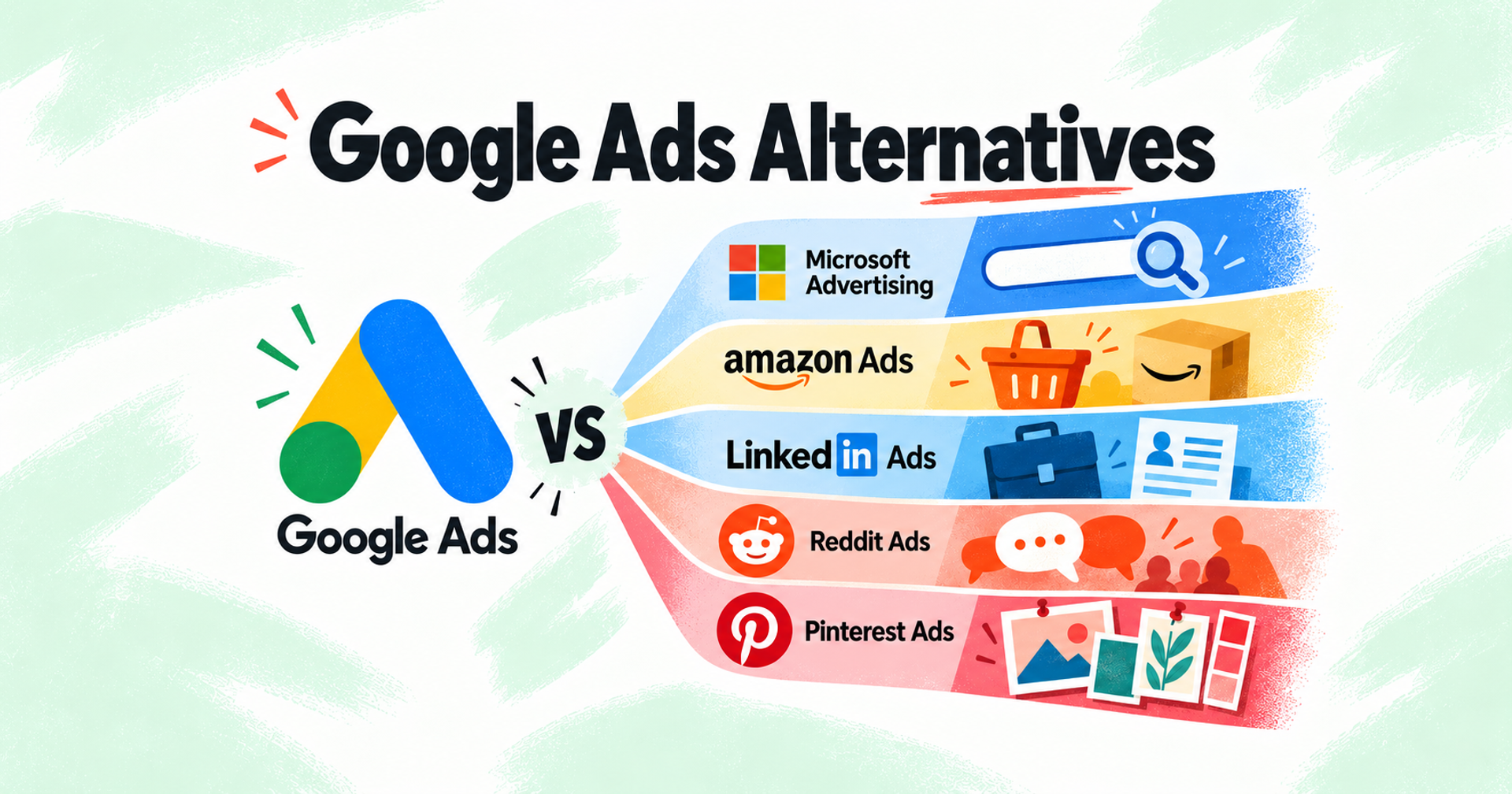
Microsoft Advertising is the closest search-ad alternative in this comparison. Amazon Sponsored Products is relevant when you sell eligible products on Amazon. LinkedIn Ads lets you build around a professional audience, Reddit Ads around communities and conversations, and Pinterest Ads around visual discovery and shopping.
Those five Google Ads alternatives solve different acquisition problems. A retailer promoting an Amazon listing and a consultancy seeking a qualified business lead should not choose a platform from the same cheapest-click ranking. The destination, audience and action you want matter more than a familiar campaign dashboard.
If you're researching Google Ads alternatives for small business, use this guide to choose one sensible next test rather than divide a limited budget across every channel. We reviewed official US-facing product, billing and setup documentation on October 20, 2026. This is a documentation-based comparison; we did not run campaigns, measure account-level CPCs or test advertising returns.
A cheaper click can buy a more expensive lead
Consider two hypothetical campaigns, each spending US$1,000 on media. These figures are invented teaching inputs, not platform benchmarks or predictions.
| Illustrative result | Campaign A | Campaign B |
|---|---|---|
| Media spend | US$1,000 | US$1,000 |
| Average cost per click | US$5 | US$2 |
| Clicks purchased | 200 | 500 |
| Clicks becoming qualified leads | 10% | 2% |
| Qualified leads | 20 | 10 |
| Media cost per qualified lead | US$50 | US$100 |
Campaign B buys more traffic at a lower click price, but produces fewer qualified leads. The calculation is spend divided by qualified leads; it excludes creative production, management and sales follow-up. For a shop, substitute an outcome such as profitable orders and include the relevant product and selling costs in the business decision.
This is the problem with treating cheaper alternatives to Google Ads as a fixed list of bargain networks. The public sources reviewed do not establish a universal lowest CPC, acquisition cost or return. Compare the same business outcome, use a consistent qualification definition and allow for different purchase timelines.
Microsoft Advertising: when the search itself is the useful signal
Start here if you want to keep a search-led acquisition model. Microsoft Advertising offers search alongside shopping, display, video and other campaign types. It is the most direct route in this shortlist for evaluating a campaign built around people actively looking for a product or service, rather than designing an entirely new discovery experience.
That makes an existing Google Search campaign a useful starting asset. Microsoft's Import Tools support importing Google Ads campaign components, with the available settings and assets varying by source and campaign type. You can select campaigns and customize bids, budgets, targeting and other supported elements. Recurring imports are also documented.
Treat that convenience as a setup aid. Review imported keywords, locations, exclusions, landing pages, budgets and creative before enabling delivery. A supported import does not establish that the new audience will respond like the old one, or that every Google campaign feature has an identical equivalent. Recurring imports also need an owner who understands which source changes should continue flowing through.
For cost, use the chosen campaign's billing model rather than a software subscription comparison. Microsoft's cost-control guidance distinguishes click-based pricing from impression- and view-based models. Search CPC depends on bidding and competition; paying for a click does not mean paying only when a customer buys.
Measurement needs its own setup. Microsoft's conversion-tracking documentation describes Universal Event Tracking, or UET, for collecting site activity and measuring conversion goals. Confirm that the intended purchase or lead event is recorded before interpreting the new campaign's reported efficiency. This is a closer search replacement, not a promise of lower costs or equal volume.
Amazon Sponsored Products: when the listing is the destination
Amazon Sponsored Products belongs in the comparison for a retailer whose acquisition goal is to sell an eligible Amazon product. The ads promote individual listings and take shoppers to the advertised product detail page. They can appear in Amazon shopping results and on product pages, as well as eligible placements beyond Amazon described in the current product documentation.
That destination is the important limitation. Sponsored Products is not a substitute for sending a prospective consulting client to your website's enquiry form. Nor does it solve every retailer's goal of building a direct relationship through its own storefront. It is a product-sales route within a specific selling environment.
The official page lists eligibility for professional sellers, vendors, book vendors, KDP authors and agencies, with product-category and Featured Offer conditions. Establish eligibility for your actual products first. An advertising account alone is not evidence that every listing can run; stock and product status also matter.
Sponsored Products uses cost-per-click pricing. Amazon states that campaigns have no monthly or upfront fees: you set bids and pay when shoppers click. That describes campaign charges, not an exemption from seller, product, fulfillment or other business costs. No fixed CPC can be quoted from this documentation as the price your category will pay.
Moving a Google Shopping budget here means selecting eligible listings, checking product information, setting keyword or product targeting, and using Amazon's campaign reports. It is a rebuild around the listing, not a claimed one-click campaign transfer. The product page also warns that daily budgets are not paced throughout the day, so a small allocation can be consumed quickly. Review its calendar-month budget treatment before treating a daily setting as an evenly spread schedule.
Choose this route when the listing, margin and fulfillment model support the advertising objective. Judge it on the business economics of those product sales, rather than comparing an Amazon click directly with a website lead.
LinkedIn Ads: when who the buyer is matters
LinkedIn Ads warrants a look when a professional identity helps define the audience. Its targeting documentation describes criteria such as job title, company and industry, as well as matched-audience approaches. That is useful for a B2B offer that needs to reach a particular business role or account type.
The switch changes the signal behind the campaign. A relevant job title does not establish that the person is searching for your service today. Your offer and creative have to make the next action worthwhile, whether you are promoting a useful resource, a demonstration or another business-specific proposition. Do not copy a search ad and assume the same buying moment exists in a professional feed.
LinkedIn's pricing explanation is auction-based and objective-dependent. The objective determines available formats, bidding options and billable events. For example, its Website Visits explanation charges for website-link clicks. It would be inaccurate to describe every LinkedIn campaign as paying only for a qualified lead or to assign a universal monthly package price.
For website outcomes, the LinkedIn Insight Tag supports conversion tracking and website retargeting. Plan measurement and lead qualification before shifting spend. A form completion and an accepted sales opportunity are different outcomes; the CRM or sales team should help determine whether the enquiries meet the buying criteria.
Choose LinkedIn when the professional audience is a meaningful part of your hypothesis. Its targeting gives you a reason to test, not evidence of a lower acquisition cost. Budget for a suitable offer, creative and follow-up process alongside the media spend, and build the campaign for LinkedIn's objectives rather than assuming your Google setup transfers intact.
Reddit Ads: when the conversation reveals the need
Reddit Ads offers a different route to relevance. Its targeting page describes community and interest targeting, plus keyword targeting around words and conversations people engage with. This can be useful when your audience discusses a problem or product category in identifiable communities.
Keyword targeting here should not be mistaken for the same event as a search query. A person reading a discussion may be researching, comparing experiences or simply participating. Build the ad around a clear explanation and an appropriate next step; do not assume that keyword relevance proves immediate purchase intent.
Reddit's advertising-cost guide describes an auction, bidding strategies and daily or lifetime budgets. Its campaign overview ties available ad and bidding choices to the objective. The correct price comparison therefore starts with the selected campaign and billable action, not a generalized claim that Reddit traffic is cheap.
There is also a distinction between being able to start and having enough budget for a particular optimization approach. Reddit's success guidance recommends US$100 or more per day for Purchase events with lowest-cost bids, and suggests other events for lower budgets. That is a vendor recommendation for a specific setup, not a universal account minimum or a promise of results.
The same guidance calls for the Reddit Pixel and discusses the Conversions API. Validate your chosen events, audience, creative and reporting before moving a larger allocation. If your business cannot support a useful test for the desired outcome, choose a narrower experiment or another channel. Do not split a small budget merely to claim a presence on a fifth platform.
Pinterest Ads: when the product benefits from being discovered visually
Pinterest is a relevant partial alternative for products or services that can be explained through visual ideas. Its advertising page describes formats, audience strategies and keyword or interest targeting. The practical appeal is the ability to present an idea or product while someone explores possibilities, rather than depend entirely on the exact search terms you already buy.
This route requires suitable creative. A product image, a useful example or a clear visual explanation has work to do before the visitor reaches the landing page. If the business relies on immediate service enquiries and cannot express a relevant proposition in this setting, Pinterest should not become the default replacement just because it is another place to advertise.
Pinterest says advertisers control spend and bids, with manual and automated bidding options. Its Ads Manager guidance distinguishes lifetime, average daily and fixed daily budgeting, and describes maximum CPC for relevant traffic goals. Read the chosen budget mode carefully: an average daily setting and a fixed daily setting are different instructions, not interchangeable labels.
Retailers considering shopping campaigns should also check the official shopping setup guide. It calls for connecting a catalog and implementing tracking signals such as the Pinterest tag. The Ads Manager guide also links the Conversions API for measurement and audience work. Account for catalog maintenance and creative production alongside bids and media spend.
The migration task is to adapt the offer, visual assets, product feed where relevant, destination and events to Pinterest. This research does not establish a complete direct Google Ads import route into Pinterest. Choose it for a plausible visual-discovery or shopping objective and evaluate what visitors do after arriving, rather than count impressions or saves as equivalent to completed sales.
What can you carry across—and what needs rebuilding?
A tested offer, a useful landing page and a clear definition of a qualified lead remain valuable outside Google. They still need to be checked against the new ad format, audience and destination. A product listing campaign may lead somewhere entirely different from your website campaign.
Microsoft's documented Google import route can reduce setup work for supported components. For the other platforms in this guide, plan a channel-specific build unless the vendor verifies a suitable import path for your exact campaign. We have not established a universal way to transfer campaigns, historical optimization signals or remarketing eligibility between these five systems.
Set up the destination platform's measurement deliberately. UET, the LinkedIn Insight Tag, Reddit Pixel and the Pinterest tag are separate tools; the existence of a Google tag is not evidence that another platform is measuring your events. Use the appropriate account and consent settings for your implementation, and check the event name, destination, value and deduplication behavior where relevant. These are recommended implementation checks, not tests performed for this article.
Choose a reporting window that makes sense for the purchase. Record media spend, qualified leads or orders, lead acceptance, and the additional creative or management work. For a B2B campaign, a lower immediate form-fill count can mean something different from a lower eventual opportunity count. Keep the definitions consistent enough to make the decision useful.
Pick one next test, and keep what already works
For a search-led local or website business, begin by assessing Microsoft Advertising's audience and supported import options. For eligible Amazon product sales, assess Sponsored Products against listing-level economics. For a defined professional buyer, evaluate LinkedIn. For a relevant community conversation, evaluate Reddit. For a visual proposition or shopping discovery, evaluate Pinterest.
You do not need to leave Google Ads altogether to learn from another channel. Keep campaigns that meet your actual business requirements while you evaluate a separately bounded test. Google's budget guidance also emphasizes the role of business and location in budgeting; another advertiser's budget is not your required spend.
If Google already produces qualified enquiries or profitable orders, the new platform must earn its allocation. If measurement is broken, changing the platform alone will not establish what works. Make the first move a decision you can evaluate, not a promise to replace every Google campaign at once.