A request can return a fluent answer while breaking the application around it. The JSON may no longer match your schema, a tool argument may change, or your streaming parser may expect an event the new provider never sends. Those are the differences that matter when choosing an OpenAI API alternative.
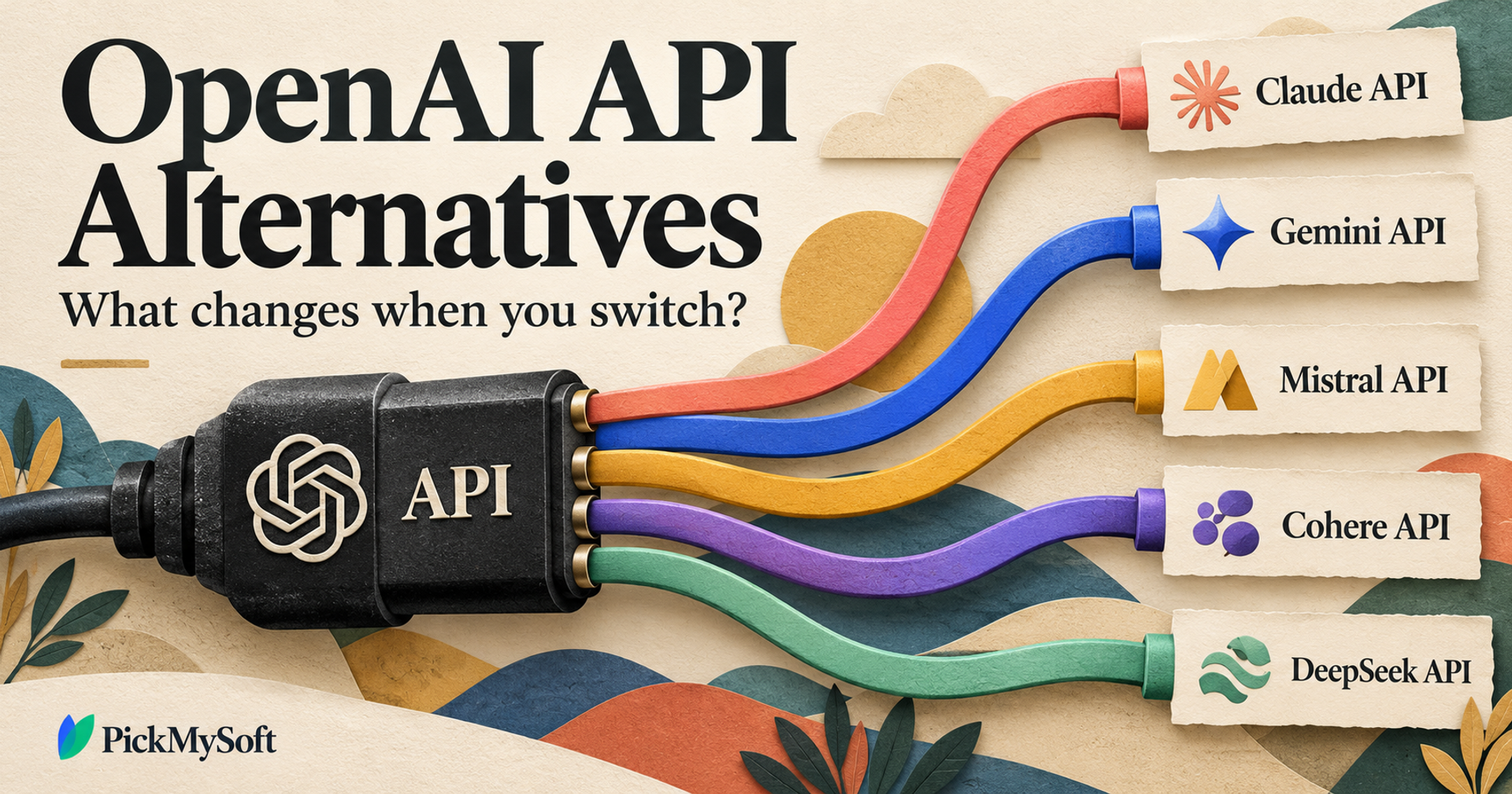
For an existing application, start with Claude API when you want to evaluate Anthropic's models and native features, Gemini API for Google's model family and supported multimodal workflows, and Mistral API when model choice and open-weight options affect the decision. Cohere API is particularly relevant to retrieval systems. DeepSeek API offers another route for evaluating a documented compatible request format.
This guide compares five providers using official documentation checked on 23 October 2026. It is intended for developers choosing an integration, rather than people replacing a chat subscription. We did not run a comparative quality, latency or reliability benchmark.
Compare the part of the API your application actually uses
An OpenAI-compatible endpoint is useful for getting an experiment started. It is not a promise that every request field, tool, model capability or state-management feature transfers.
OpenAI's own Responses migration guide distinguishes Chat Completions messages from Responses items, function-call formats and conversation-state handling. Before assessing another provider's compatibility claim, identify which of those behaviours your application depends on.
| Existing requirement | What to demonstrate on the alternative |
|---|---|
| Validated JSON | The required fields and types survive realistic inputs and failures |
| Function calls | Names, arguments, tool results and repeated calls work together |
| Streaming | Your parser handles events, interruptions and final usage reporting |
| Document answers | The actual file types, retrieval path and citations are supported |
| Conversation state | History and tool context remain available in the expected form |
Keep your current OpenAI integration if it already meets these requirements and the proposed move offers no clear advantage. A new provider can also serve one bounded task without replacing the rest of your stack.
The shortlist and its important limits
| Provider | Reason to evaluate | Migration boundary | Cost basis to check |
|---|---|---|---|
| Claude API | Anthropic models, document features and native tool workflows | Compatibility layer omits some native capabilities and ignores fields | Model input/output, cache writes/reads and extra features |
| Gemini API | Google model family and supported multimodal inputs | Compatible calls still have model-specific parameters and limits | Model, modality, thinking, tools and paid versus free tier |
| Mistral API | Hosted model choice and selected open-weight models | Model licences and service features differ | Token rates or task-specific billing; separate hosting costs |
| Cohere API | Generation, embeddings and reranking for retrieval | Different endpoints and model-specific production access | Generation plus retrieval services and deployment terms |
| DeepSeek API | Evaluate supported compatible chat requests | Model aliases and supported behaviour need checking | Current selected-model rates and account terms |
We chose these providers for distinct integration decisions, not a universal ranking. Consumer chat apps, gateways and self-hosting servers are different categories. A gateway may help route requests, but it does not itself establish that the underlying models meet your requirements.
1. Claude API: use compatibility to evaluate, then choose the integration
Anthropic's OpenAI SDK compatibility documentation makes an unusually useful distinction: its compatibility layer is primarily for testing and comparing models, and is not presented as a long-term production solution for most use cases.
The documented limitations matter. The layer ignores the strict function-calling parameter and the response-format field. Prompt caching is available through the native API rather than that compatibility layer. An application that validates tool arguments or relies on cached prompts should therefore evaluate the native Claude integration, not judge the migration from a basic chat response.
Choose Claude when its behaviour on your actual tasks justifies the integration work. For document workflows, investigate the native PDF and citation capabilities described in the documentation. Rework prompts where necessary rather than assuming a prompt tuned to another model will behave identically.
For a current pricing example, the official API rate table lists Claude Sonnet 5.5 at US$2 per million input tokens and US$10 per million output tokens. These are base token rates; cache operations and additional features need separate consideration. They are not a cost estimate for your application or a claim that this model matches another provider's quality.
2. Gemini API: check the model and input type together
Google documents how to call Gemini through the OpenAI libraries by changing the key, base URL and model. Its compatibility guide includes streaming, function calling and image-input examples, making it a practical starting point for an existing integration.
The important qualification is that capabilities remain model-dependent. The documentation maps reasoning effort to Gemini thinking controls and describes supported parameters for different operations. An example that works for text generation does not establish that your audio, image or video path uses the same endpoint or options.
Shortlist Gemini when you have a defined multimodal task or want to compare Google's models against your current workload. Test the precise input format and output your application needs. Avoid adding a model simply because it appears beside another model in the same catalogue.
The pricing page separates limited free access from paid production usage. Not every model is available on the free tier, and tool or modality charges can change the budget. It also distinguishes how content is used on free and paid tiers; review the terms for the account you intend to use before sending internal material.
3. Mistral API: separate the hosted service from open weights
Mistral's model overview covers commercial and open-weight models, with different licences and capabilities. That makes it relevant when you want to compare a hosted API with the possibility of operating a suitable model elsewhere.
Those are separate decisions. A model's available weights do not include the hosted platform's infrastructure, support or every associated service. Check the exact model licence and your intended use. Then estimate the hardware and operational work if running it yourself is part of the plan.
For hosted evaluation, choose a specific model and task. A text-generation model, OCR service and speech model have different billing units and integration requirements. Treat them as individual components rather than assuming one generic API replacement covers the entire application.
The standard API pricing table lists Mistral Small 4 at US$0.15 per million input tokens and US$0.60 per million output tokens, with cached input listed separately. This is one model's published rate, not an equivalent-performance comparison with Sonnet or another model. Check the currency, service tier and current model availability before budgeting.
4. Cohere API: assess the retrieval pipeline, not only the answer
Cohere's model documentation separates Command generation models, Embed and Rerank services. That combination deserves attention when your application searches a document collection before generating an answer.
The useful question is where the current pipeline fails. If relevant passages never reach the generator, changing the chat model alone may leave the problem unresolved. Cohere's retrieval components let you evaluate that stage separately from answer generation. This is a reason to investigate the product, not evidence that it will improve your search results without testing.
Replacing embeddings also requires a migration plan. Compare the new vector representation and index configuration, and establish how documents will be reprocessed. Keep permissions and source references attached to the retrieved material so a model change does not obscure which documents an answer used.
Cohere distinguishes evaluation keys from production access. Its rate-limit documentation also notes that some newer model variants require a production-access conversation even when you have a production key. The pricing FAQ says trial keys are not for commercial or production use. Budget for the selected generation and retrieval services together, and confirm the exact model's access and pricing before rollout.
5. DeepSeek API: validate the current model behind the familiar request
DeepSeek documents compatible API formats and examples using the OpenAI SDK. Its quickstart identifies the provider's own key, base URL and model names, which can help developers set up a separate evaluation path.
Model identity deserves attention. The documentation explains that some legacy names remain accepted while requests are served by a newer model. A working model string is therefore not proof that the model behind your integration has stayed unchanged. Record the documented mapping and monitor its lifecycle before relying on repeatable behaviour.
Consider DeepSeek for tasks you can evaluate with representative inputs and explicit acceptance criteria. Verify tool calls, structured responses and streaming requirements individually. A compatible request format should not be described as full replacement coverage for OpenAI's hosted tools or conversation services.
Confirm the current selected-model rate in the provider's billing information before making a cost commitment. This article does not quote a numeric DeepSeek rate or declare it the cheapest provider. Include token usage, retries and the work required to operate a second integration in your comparison.
Compare cost per accepted result
A lower token price helps only when the result meets the task's requirements. Log the complete request: input, output, any billable reasoning, cache operations and separately charged tools. Add retries and failed outputs that require another attempt.
For a document workflow, include extraction, embedding, retrieval and generation where those are separate services. For an interactive product, compare latency and failure handling as well as the invoice. Different tokenizers can also produce different usage totals for the same source text.
Use provider rate tables to estimate a budget, then measure your own representative requests. The prices above are examples of billing structure; the article has not established equal model quality or measured application savings.
A provider change needs an acceptance record
Keep a small set of permitted examples covering ordinary requests, long inputs, ambiguous instructions, invalid tool arguments and interrupted streams. Specify what counts as success before examining the new outputs. Include the point where your application must reject an answer or ask for clarification.
Record model, request settings, response validation, total cost and any manual correction. Test the application's recovery path, not just the successful response. Then move a bounded task behind a reversible configuration change while retaining the previous route.
Keep prompts and application-owned conversation history exportable. Check whether provider-hosted files or state need rebuilding rather than assuming an API key change transfers them. For a consumer assistant comparison instead, see PickMySoft's Claude alternatives guide.
Questions to settle before switching
Is there a free OpenAI API alternative for production?
Gemini offers limited free access to certain models, subject to current allowances and terms. Cohere evaluation keys should not be treated as free production access. Available model weights also do not make hosting and administration free.
Can I keep using the OpenAI SDK?
Some providers document compatible endpoints. Check the supported operations and parameters for your specific workflow. Claude's compatibility layer, for example, ignores fields that can matter to validated outputs; native integration may be the appropriate destination.
Should I replace OpenAI everywhere at once?
Only after the replacement has been evaluated across every dependency. A narrower move is easier to assess: compare one task, establish acceptance and recovery criteria, and retain the working integration for tasks the alternative has not yet covered.
Which provider belongs on my first shortlist?
Evaluate Claude for its models and native workflows, Gemini for supported Google multimodal use cases, Mistral for hosted versus open-weight choices, Cohere for retrieval components, and DeepSeek for a supported compatible chat integration. Choose the pair that addresses the problem you are actually trying to solve.