Ranking #1 on Google doesn't mean much when a growing share of buyers never click past the AI-generated answer at the top of the page. AI search visibility optimization tools exist to answer a question traditional SEO software can't: does ChatGPT actually mention your brand when someone asks for a recommendation?
We compared eight platforms that answer it: Profound, Peec AI, Otterly.AI, Scrunch AI, Wellows, Rankscale, AthenaHQ and Xfunnel. Profound is the best overall pick for AI-sourced traffic attribution, while Otterly.AI is the best low-cost way in, with a published $29/month entry plan.
Every price and plan limit was re-checked against each vendor's own pricing page and documentation in November 2026. The differences come down to pricing transparency, how many AI engines you can track on the plan you can afford, whether the tool measures real AI-driven traffic, and whether it offers an official MCP server.
Last updated November 11, 2026.
Why You Need AI Search Visibility Optimization Tools#
Traditional rank trackers tell you where a page sits in a list of blue links. They say nothing about whether ChatGPT, Perplexity or Google's AI Overviews mention your brand at all, how they describe you, or which competitor they recommend instead. AI visibility tools fill that gap by running a fixed set of buyer-style prompts against each engine on a schedule and recording whether you appear, in what position, with what sentiment and with which cited sources.
That data matters for three reasons. A competitor can pull ahead in AI answers long before it shows up in your revenue, and share-of-citation trends flag the shift while there is still time to respond. Being mentioned negatively is worse than not being mentioned, so sentiment tracking is not a nice-to-have. And the better platforms close the loop by showing the traffic AI answers actually send you, and by turning a visibility score into a concrete list of pages to fix, write or pitch.
How We Evaluated These Tools#
We assessed each tool against five criteria: pricing transparency and value, breadth of AI engine coverage, official MCP and API maturity, whether traffic attribution ships alongside mention tracking, and how usable the entry tier really is. This is desk research, not hands-on testing. Every price, plan limit and MCP claim comes from the vendor's own pricing page or documentation, re-checked in November 2026, and the order reflects our editorial judgment of those facts. Where a vendor doesn't publish something, such as a price for an Enterprise plan or a documented MCP server, we say so rather than guess. Prices are monthly list prices in USD, and most vendors discount annual billing by roughly 15 to 17 percent.
Best 8 AI Search Visibility Optimization Tools in 2026#
1. Profound#
Profound goes further than counting AI mentions. Its Agent Analytics attributes real site traffic back to AI answers across unlimited domains, wired into Cloudflare, AWS, Akamai, Fastly, Vercel, Google Analytics and other infrastructure, which makes it the only platform here that connects visibility to visits out of the box. Around that sits Answer Engine Insights, which tracks how your brand and competitors appear across AI platforms in terms of citations, sentiment, ranking and share of voice, plus Prompt Volumes, which estimates what people are actually asking AI engines, and an AI Marketer with reusable agents that turn those findings into content and campaign work.
| Plan / pricing detail | Price / billing | Included limits and notes |
|---|---|---|
| Trial | Free | 50 prompts daily for 7 days across ChatGPT, Gemini and Google AI Overviews; limited AI Marketer credits; recommended prompts cannot be customized; one language and one region; unlimited seats. |
| Enterprise | Custom quote | Up to ten answer engines: ChatGPT, Perplexity, Google AI Mode, Gemini, DeepSeek, Claude, AI Overviews, Exa Search, Muse Spark and Qwen. Tailored prompts, daily tracking, ChatGPT Shopping, all-time history, CSV/JSON exports, SSO, SOC 2 compliance and unlimited seats. |
| Agency Growth | Price not specified | Self-serve agency plan with 400 credits a month per client workspace. |
| Purchase options | Sales-led beyond the trial for a single brand | No self-serve Starter or Growth tiers are listed. |
Trade-offs. The cost is access. Beyond the trial there is no public price and no self-serve path for a single brand, the trial's canned prompt set makes it a demo rather than a real month-long test, and both the REST API and the MCP server are Enterprise features.
MCP, API and platforms. Profound documents a hosted MCP server at mcp.tryprofound.com/mcp, available on Enterprise, that lets AI assistants pull visibility, sentiment, citation, shopping and Agent Analytics reports, manage prompts and run Profound workflows. The API is also Enterprise-only. It is a cloud platform used through a web dashboard, with traffic integrations for Akamai, AWS, Cloudflare, Fastly, Google Analytics, Google Cloud, Netlify, Vercel and WordPress.
Best for. Teams that want AI-sourced traffic attribution alongside visibility tracking and don't mind buying through sales. It is the most complete platform here, held back mainly by custom-only pricing and Enterprise-gated API and MCP access. Skip it if you need a self-serve plan for a single brand or an API without an Enterprise contract.
2. Peec AI#
Peec AI is the cleanest middle path in this comparison: published monthly prices, unlimited users on every plan, and an official MCP server from the cheapest tier. The platform tracks visibility, position, sentiment and share of voice daily against unlimited competitors, then goes beyond the score with source analytics, gap analysis that shows which sources name your competitors but not you, ranked actions grouped by owned pages, editorial coverage, reference sites and UGC communities, SKU-level AI shopping tracking, brand perception scoring and agent analytics for AI bot visits.
| Plan / pricing detail | Price / billing | Included limits and notes |
|---|---|---|
| Starter | $95/month | 50 prompts; one project; 4,500 AI answers/month; extra models cost $30/month each. |
| Pro | $245/month | 150 prompts; two projects; 13,500 AI answers/month; three countries; extra models cost $70/month each. |
| Advanced | $495/month | 350 prompts; five projects; 31,500 AI answers/month; three countries; Looker Studio connector; extra models cost $140/month each. |
| Enterprise | Custom; annual contract | Unlimited prompts; up to 13 models; SSO and dedicated support. |
| Billing and coverage | About 15% off annual billing; free trial available | Standard plans track three chosen models daily from ChatGPT, Google AI Mode, AI Overviews, Microsoft Copilot, Gemini and Naver AI. Extra models, including Perplexity, cost extra as shown above. |
Trade-offs. The three-model cap is the main limit: tracking Perplexity or a fourth engine costs extra, so the real price rises with coverage. The REST API starts at Pro, SSO is Enterprise-only, and Starter support is chat rather than chat plus email.
MCP, API and platforms. Peec AI's official MCP server (api.peec.ai/mcp) works with Claude, Cursor, VS Code and Windsurf over OAuth or a personal access token. It lets an assistant check visibility across the engines Peec tracks, compare competitors, inspect cited sources, pull ranked actions and, with owner permission, create or edit prompts and topics. The API is included from Pro. Peec is cloud-based, with a web dashboard, a Looker Studio connector and CDN and log integrations such as Cloudflare, Vercel, AWS and WordPress for agent analytics.
Best for. SEO and marketing teams that want published pricing, unlimited seats and MCP access without an Enterprise contract, and can live with three tracked models per plan. Skip it if you need more than three engines tracked without paying for add-ons.
3. Otterly.AI#
Otterly.AI is the most approachable way to start. There is a free trial, the entry plan is $29 a month, and every plan includes unlimited brands, competitors, team members, countries and languages. It tracks brand coverage, rank and sentiment, citation sources and domains, share of voice and a Brand Visibility Index, and it bundles tools that rivals often charge for separately: a prompt research tool, query fan-out analysis, ChatGPT Ads tracking and a GEO audit that checks crawlability and content readiness for AI engines.
| Plan / pricing detail | Price / billing | Included limits and notes |
|---|---|---|
| Lite | $29/month | 20 prompts; 2,000 credits/month. |
| Standard | $189/month | 160 prompts; 15,000 credits/month. |
| Premium | $489/month | 535 prompts; 50,000 credits/month. Weekly tracking stretches credits about sevenfold. |
| Enterprise | Custom quote | From 1,000 prompts; unlimited engines; SSO and a dedicated customer success manager. |
| Credit rules | One credit = one prompt checked once on one engine | Daily tracking on one engine uses 31 credits per prompt/month. Claude answers cost three credits. Published prompt counts assume roughly three engines checked daily. |
| Billing and engines | About 15% off annual billing | Each standard plan can track ChatGPT, Google AI Overviews, Perplexity, Microsoft Copilot, Google AI Mode, Gemini and Claude, subject to credits. |
Trade-offs. The cheapest plan is small. Lite excludes API and MCP access, agent analytics and the Data Studio connector, limits you to one workspace and three recommendations a week, and can't buy extra credit packs. You need Standard at $189 to unlock the integrations, which is where Otterly stops being the cheapest option.
MCP, API and platforms. Standard includes 2,000 API requests, 2,000 MCP requests and 200,000 agent analytics events a month, and Premium raises those to 5,000, 5,000 and one million. The official MCP server (otterly.ai/features/mcp) uses OAuth over streamable HTTP and works with Claude, ChatGPT, Cursor, n8n and Zapier, exposing brand reports, prompts and responses, citations, GEO audits and recommendations. Extra credits are available as add-ons, $65 for 5,000 on Standard and $99 for 10,000 on Premium. Otterly is cloud-based, with a web dashboard and a Looker Studio connector.
Best for. Solo marketers and small teams that want the lowest real entry price and a clearly published upgrade path to API and MCP access. Skip it if you need API or MCP access on the cheapest plan, since Lite excludes both.
4. Scrunch AI#
Scrunch AI treats AI search as a two-sided problem: how your brand appears in AI answers, and how AI agents experience your website. Alongside prompt monitoring and citation tracking, it measures AI agent and bot traffic to your site, runs site audits and page optimizations, and, on Enterprise, offers an Agent Experience Platform (AXP) that serves an optimized version of your site to AI agents. It also includes sentiment analysis, insights and recommendations, funnel-stage prompt tagging and a shopping view for product-level performance.
| Plan / pricing detail | Price / billing | Included limits and notes |
|---|---|---|
| Core | $250/month | 125 unique prompts; 5,000 responses/month; five site audits and one page optimization/month; one brand workspace; five user licenses and five competitors; one country, language and persona. Tracks ChatGPT, Perplexity, Google AI Overviews and Copilot. Includes a 7-day free trial, Google SSO and email support. |
| Enterprise | Custom quote | Adds Claude, Gemini, Meta AI, Google AI Mode and Grok for nine LLMs total; unlimited countries; full site audits; AXP; product observability; Looker Studio; SAML/OIDC SSO; Slack support and a dedicated account team. |
Trade-offs. Engine coverage is the catch: Core doesn't track Claude, Gemini, Meta AI or Google AI Mode, which sit behind the Enterprise quote. At $250 it is also the second-highest published entry price here, and its limits (one country, one workspace, 125 prompts) suit a single focused brand rather than a portfolio.
MCP, API and platforms. Scrunch documents an MCP server, with a help-center guide for connecting it to assistants such as Claude, ChatGPT, Copilot and Cursor. Its pricing page, however, lists MCP access, the Query and Advanced APIs, CLI access and Looker Studio under Enterprise only, so treat all of them as Enterprise features. It is a cloud platform used through a web dashboard.
Best for. Brands that care about how AI agents crawl and consume their site, and want page-level audits and bot-traffic monitoring alongside prompt tracking. Skip it if you need Claude, Gemini or Google AI Mode tracking below Enterprise.
5. Wellows#
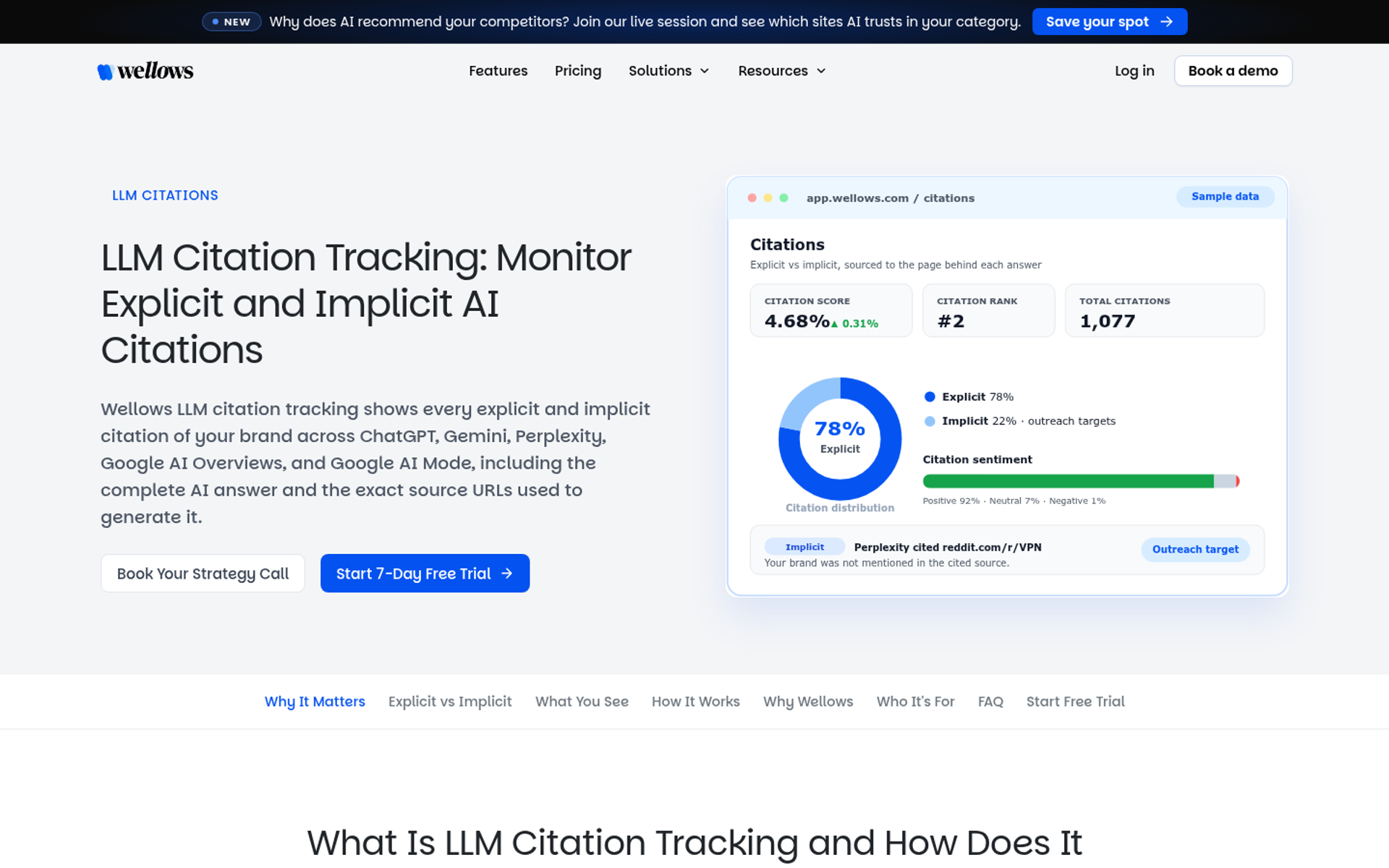
Wellows' AI citation tracking counts citations two ways: when an AI answer names your brand outright, and when your domain is cited in the sources without your name appearing. Every plan includes all five engines it covers and unlimited projects, prompts and seats. The only difference between plans is the monthly balance of AI answers.
| Plan / pricing detail | Price / billing | Included limits and notes |
|---|---|---|
| Basic | $29/month | 1,800 AI answers; about 12 prompts on all 5 engines daily. |
| Standard | $97/month | 6,500 AI answers. |
| Growth | $249/month | 18,000 AI answers. |
| Scale | $497/month | 36,000 AI answers. |
| Custom balances | Available for larger portfolios | Contact Wellows for a custom balance. |
| Usage and trial | Every plan has a 7-day free trial | One answer = 1 prompt × 1 engine × 1 day. Weekly tracking stretches a balance about 7× further. |
Top features:
- Tracks ChatGPT, Gemini, Perplexity, Google AI Overviews and AI Mode on every plan
- Citation tracking for both named mentions and cited domains
- Sourced sentiment, traced back to the page the model read
- Competitive rank movement and daily change down to the URL
- Quick Wins and Content Opportunities, ranked by expected impact
- KIVA writing agent, which drafts pages against your own Google Search Console data
- Outreach list of the third-party pages AI engines already cite, with contacts
- White-label client dashboards (per client and per country), per-project reporting and exports
Pros:
- All five engines from the $29 entry plan, with no engine add-ons
- Unlimited projects, prompts and seats on every plan
- Google Search Console and the WordPress plugin included on every plan, not sold as add-ons
Cons:
- No Claude or Copilot tracking
- No public API or MCP server documented
- No top-ups: if the monthly balance runs out, tracking pauses until the next billing date
AI/MCP Integration: Not confirmed. No MCP server is documented as of November 2026.
API Integration: Not confirmed. No public API is documented.
Cloud Based: Yes.
Platforms: Web dashboard; Google Search Console and WordPress plugin integrations.
Best for: agencies and in-house teams that want all five major AI engines and unlimited seats from the entry tier, plus a list of what to fix and who to contact.
6. Rankscale#
Rankscale is the broadest tracker in this comparison and one of the cheapest to start with. Its plans cover ChatGPT, Perplexity, Google AI Mode and AI Overviews, Gemini, DeepSeek, Mistral, Claude, Microsoft Copilot and Meta's Muse Spark, and its credit calculator lists 15 more engine and model variants. It tracks unlimited search terms in all regions on schedules from hourly to monthly, and layers on citation and source analysis, competitor benchmarking, sentiment, local results, AI visits, shopping and ad analytics, query fan-out, page audits and Scout recommendations.
| Plan / pricing detail | Price / billing | Included limits and notes |
|---|---|---|
| Essentials | $20/month; yearly billing only | Credit-based plan. |
| Pro | $99/month | 1,200 credits; 7-day free trial; unused credits roll over up to 2×. |
| Pro+ | $229/month | 3,000 credits; unused credits roll over up to 2×. |
| Growth | $385/month | 5,500 credits; unused credits roll over up to 3×. |
| Enterprise | $780/month | 12,000 credits; unused credits roll over up to 3×. |
| Billing and custom plans | About 15% off yearly billing; custom plans on request | Pro and above include unlimited seats, CSV and Sheets exports, Looker Studio integration and Slack support. |
| Credit rules | Typical query: about ¼ credit per engine per prompt | DeepSeek costs one credit and Claude two; heavier engines consume credits faster. |
Trade-offs. Credit-based billing is harder to forecast than a flat prompt count, so the calculator on the pricing page is worth using before you commit. Essentials also leaves out sentiment analysis, custom dashboards, local results, AI visits, shopping and ad analytics and data exports, so most teams will want Pro, and white-labeled dashboard links are reserved for Growth and Enterprise.
MCP, API and platforms. Rankscale's MCP server, labeled beta, is included on every plan, even Essentials. It connects Claude, ChatGPT, Cursor and OpenAI Codex to your live data, with read access always on and writes or credit-spending runs as opt-in permissions. A REST API starts at Pro+ ($229), with Growth and Enterprise adding metrics and share links. Rankscale is a cloud platform with a web dashboard and a Looker Studio integration.
Best for. Teams that want the widest engine coverage and MCP access at a low entry price, and are comfortable managing a credit budget. Skip it if you want a flat, predictable prompt count instead of credits.
7. AthenaHQ#
AthenaHQ is the only vendor here with a free tier that isn't a time-limited trial, and its paid plan tracks 11 models. Beyond tracking, it leans on action: prompt and response analysis, sources and competitor insights, content recommendations, an Athena AI agent, a content optimization agent that learns from results, on-page and off-page GEO and SEO actions, citation intelligence and a smart robots.txt and llms.txt manager that controls AI crawler access.
| Plan / pricing detail | Price / billing | Included limits and notes |
|---|---|---|
| Essential | Free | $25 credit (300 credits); ChatGPT, Perplexity, AI Overviews, Gemini and Copilot; unlimited users. |
| Starter | $295/month; 17% discount for annual billing | 3,600 credits; one credit = one AI response; one-month rollover. Covers 11 models, adding AI Mode, Claude, Grok, DeepSeek, Meta AI and Mistral, with more on request. Unlimited topics, prompts and competitors; single-country tracking; Shopify, Webflow, Google Analytics and Search Console integrations; CSV export. |
| Enterprise | Custom quote | Negotiated credits; multi-region and multi-language support; persona targeting; SSO; audit logs; BI dashboards for Tableau, Power BI and Looker; 2-hour SLA. |
Trade-offs. Credits are the constraint: 3,600 AI responses go quickly across 11 models, and extra credits are a paid add-on billed on top of Starter, with pricing on request. Multi-country tracking, persona targeting, the advanced content agent and the BI dashboards are Enterprise-only.
MCP, API and platforms. API access is a paid add-on on Starter and included on Enterprise. We found no MCP server documented on AthenaHQ's pricing and plan pages, so MCP support isn't confirmed. It is cloud-based, with a web dashboard and integrations for Shopify, Webflow, Google Analytics and Search Console.
Best for. Teams that want to test AI visibility tracking for free before paying, then step up to a single-country plan with a content optimization agent. Skip it if you need multi-country tracking or a documented MCP server without moving to Enterprise.
8. Xfunnel#
Xfunnel starts with a free audit and moves to a custom Enterprise contract, with almost nothing in between. Its Enterprise plan is closer to a service than a dashboard, combining monitoring, audits and expert support.
| Plan / pricing detail | Price / billing | Included limits and notes |
|---|---|---|
| Starter | Free; one-time audit | 50 search queries in one language and one region. |
| Enterprise | Custom quote | Unlimited queries; daily monitoring; all languages and regions; Google Analytics referral tracking; bot detection; AI-friendly content audit; technical AEO audit; weekly expert meetings; strategy assessments and an AI Search Knowledge Library. |
What sets it apart. Managed services are the differentiator: AI-first content creation, Reddit reputation and engagement (run by a partner agency), Wikipedia strategy and maintenance, and an AI-first affiliate network. Enterprise platform coverage spans ChatGPT, ChatGPT with browsing, Perplexity, Claude, Google AI Overviews and AI Mode, Gemini, Microsoft Copilot and Grok, with Meta AI and DeepSeek listed as coming soon, while the free audit covers ChatGPT, Gemini, Claude and Perplexity.
Trade-offs. There is no published mid-tier, so the jump from free to paid is the steepest in this comparison, and Enterprise pricing is quoted individually. There is also a corporate wrinkle: Xfunnel's site announces that it has entered into an agreement to be acquired by HubSpot, so standalone plans, pricing and roadmap may change. We found no public API or MCP documentation, and the platform is a cloud web dashboard.
Best for. Teams that want a free, no-commitment look at their AI visibility first, or Enterprise buyers who want experts to handle strategy and execution rather than just a dashboard. Skip it if you want a self-serve mid-priced plan or documented API and MCP access.
Comparison Table#
The table puts the eight tools side by side. MCP and API entries reflect what each vendor's pricing page and documentation currently say, and the engine counts are the most each plan can cover, which for Peec AI, Otterly.AI and Scrunch AI depends on the plan or your credits.
| Tool | Best For | Starting Price | Engines tracked | Standout Feature | AI-MCP Support | API Integration |
|---|---|---|---|---|---|---|
| Profound | AI-sourced traffic attribution + broad engine coverage | Free 7-day trial; custom Enterprise | 3 in trial; up to 10 on Enterprise | Agent Analytics traffic attribution | Official MCP server (Enterprise) | Yes, Enterprise only |
| Peec AI | Published pricing with MCP on every plan | $95/mo (Starter) | 3 models per plan; up to 13 on Enterprise | MCP on every plan; unlimited users | Official MCP server (all plans) | Yes, from Pro |
| Otterly.AI | Lowest-cost start with a clear upgrade path | $29/mo (Lite) | About 3 on Lite; up to 7 with credits | GEO audit and prompt research included | Official MCP server (Standard and up) | Yes, from Standard |
| Scrunch AI | Agent-traffic monitoring + page audits | $250/mo (Core) | 4 on Core; more on Enterprise | AI agent traffic monitoring and AXP | MCP documented; listed on Enterprise | Enterprise only |
| Wellows | Five-engine tracking from the entry tier | $29/mo (Basic) | 5 on every plan | Citations counted two ways + outreach list | Not confirmed | Not confirmed |
| Rankscale | Broad engine coverage at a low entry price | $20/mo (Essentials, yearly only) | 10+ engines, more model variants via credits | Widest engine list; MCP on every plan | Official MCP server (beta, all plans) | Yes, from Pro+ |
| AthenaHQ | Genuinely free entry tier to test tracking | Free ($25 credit) | 5 on the free tier; 11 on Starter | Self-learning content optimization agent | Not confirmed | Paid add-on (Starter) |
| Xfunnel | Free audit + managed services | Free (one-time audit) | 4 in the free audit; 9 on Enterprise | Managed services (Wikipedia, Reddit) | Not confirmed | Not confirmed |
How to Choose an AI Search Visibility Optimization Tool#
Start with your budget. Rankscale's $20 Essentials (yearly only), Otterly.AI's $29 Lite and Wellows' $29 Basic are the three lowest entry prices, but they buy different things: Otterly's Lite covers 20 prompts on about three engines, Wellows' Basic covers about 12 prompts on all five of its engines, and Rankscale's Essentials is a stripped-down plan without sentiment, shopping or exports. Peec AI at $95 and Scrunch AI at $250 are the next steps up, while Profound and Xfunnel sell paid plans only by Enterprise quote.
Then check engine coverage. Rankscale tracks the most engines, and Otterly.AI can track seven if you spend the credits. Wellows covers five on every plan, though not Claude or Copilot. Peec AI limits each plan to three models of your choice with paid add-ons, Scrunch's Core covers four, and Profound's Enterprise covers up to ten.
Decide whether you need traffic attribution. Profound's Agent Analytics, Scrunch AI's agent traffic monitoring, Peec AI's AI referrals and crawl insights, Rankscale's AI visits and Otterly.AI's agent analytics (Standard and up) all go beyond mention counts to show how AI agents and visitors reach your site.
Check whether MCP matters. If you want assistants such as Claude or ChatGPT to query your data, Peec AI and Rankscale include MCP on every plan, Otterly.AI from Standard, and Profound and Scrunch AI on Enterprise. Wellows, AthenaHQ and Xfunnel don't document one.
Look at API access. Otterly.AI (Standard), Peec AI (Pro) and Rankscale (Pro+) are the cheapest routes to an API. Profound and Scrunch AI gate it to Enterprise, AthenaHQ sells it as a paid add-on, and Wellows and Xfunnel don't document one.
Weigh free options and trials. AthenaHQ's Essential tier and Xfunnel's Starter audit are genuinely free. Profound's Trial, Peec AI, Otterly.AI, Scrunch AI, Wellows and Rankscale's Pro plan all offer free trials, mostly seven days, so you can test most of this list before paying.
Decide how much work you want done for you. Xfunnel's Enterprise plan includes managed services such as Wikipedia maintenance and Reddit engagement. Wellows adds a ranked to-do list and an outreach list of pages AI already cites, Peec AI ranks recommended actions, and AthenaHQ and Profound use agents to draft content. The rest are mostly dashboards you act on yourself.
What Does AI Search Visibility Optimization Cost for a 10-Person Team?#
For a 10-person marketing team, seat limits matter less than prompt capacity, because Peec AI, Otterly.AI, Rankscale, Wellows and AthenaHQ all include unlimited users. Otterly.AI's Standard tier at $189 a month covers 160 prompts, API and MCP access (2,000 requests of each) and unlimited workspaces, which makes it the most straightforward real number for a team this size. Peec AI's Pro at $245 a month adds 150 prompts on three chosen models, two projects and an API, and its Advanced plan at $495 covers 350 prompts and five projects.
For a 10-person team, Wellows Standard at $97/month covers about 43 prompts on all five engines daily, and seats are unlimited, so team size doesn't change the price. Rankscale's Pro at $99 a month (1,200 credits) or Pro+ at $229 (3,000 credits) also include unlimited seats, with Pro+ adding the REST API, and AthenaHQ's Starter is $295 a month for 3,600 credits with unlimited seats.
Scrunch AI's Core is $250 a month for five user licenses and 125 prompts, so a ten-person team would likely need to talk to sales about Enterprise. Profound's paid plan beyond its 7-day trial is custom Enterprise with unlimited seats, the one to price if traffic attribution matters more than raw cost. Xfunnel has no real middle tier at all: it is a free one-time audit or a custom Enterprise contract.
To compare on one yardstick, assume about 150 prompts tracked daily, list prices and monthly billing. Otterly.AI Standard (160 prompts, $189) and Peec AI Pro (150 prompts on three chosen models, $245) fit directly. Wellows counts answers, so 150 prompts on its five engines is 22,500 answers a month: Growth's 18,000 covers about 120 prompts at $249, and Scale's 36,000 at $497 covers the full 150 with room to spare. The engine counts behind those prompts differ, so this is a rough guide to price per tracked prompt, not a like-for-like quote, and it is our arithmetic from published limits.
Final Thoughts#
Profound is the strongest overall pick if you want AI-sourced traffic attribution alongside visibility tracking. Agent Analytics is the one feature here that goes beyond counting mentions to showing actual site traffic from AI answers, and its Enterprise plan tracks up to ten engines, though you will be buying through sales. For the most common case, a team that wants to start cheaply and grow, Otterly.AI is the more practical starting point, with a genuine $29 entry tier, add-on credit packs and published API and MCP request limits at every paid tier above it.
Peec AI is worth a close look because it combines published pricing, unlimited users and MCP on every plan, even though each plan tracks only three models. Scrunch AI and Rankscale both stand out for depth: Scrunch for AI agent traffic monitoring and page-level audits, Rankscale for the broadest engine list and an MCP server on every plan at a low entry price. AthenaHQ and Xfunnel are the two to start with if you want to test AI visibility tracking for free before paying, and the free trials at Wellows, Profound, Peec AI, Otterly.AI and Scrunch AI, plus Rankscale's Pro trial, are the other low-risk ways in.
Wellows is for brands and agencies that need to see where they're cited in AI answers and what to do about it. It covers the five engines most buyers use, ChatGPT, Gemini, Perplexity, AI Overviews and AI Mode, from a $29 plan. It then turns the tracking into actions: pages to fix, pages to write and the third-party pages to get onto. The flat structure (unlimited projects, prompts and seats on every tier) suits agencies running several clients, with white-label dashboards per client.